GFT Technologies
By
Tim Culverhouse
May 18, 2026
GFT Technologies
Data model training, and lighting enhancements make help GFT's AI-powered assembly lines identify, inspect and remove defective parts.
Get news, papers, media and research delivered. Sign up for our free newsletters.
Stay up-to-date with news and resources you need to do your job. Research industry trends, compare companies and get weekly market intelligence with Robotics 24/7.

GFT Technologies
Data model training, and lighting enhancements make help GFT's AI-powered assembly lines identify, inspect and remove defective parts.
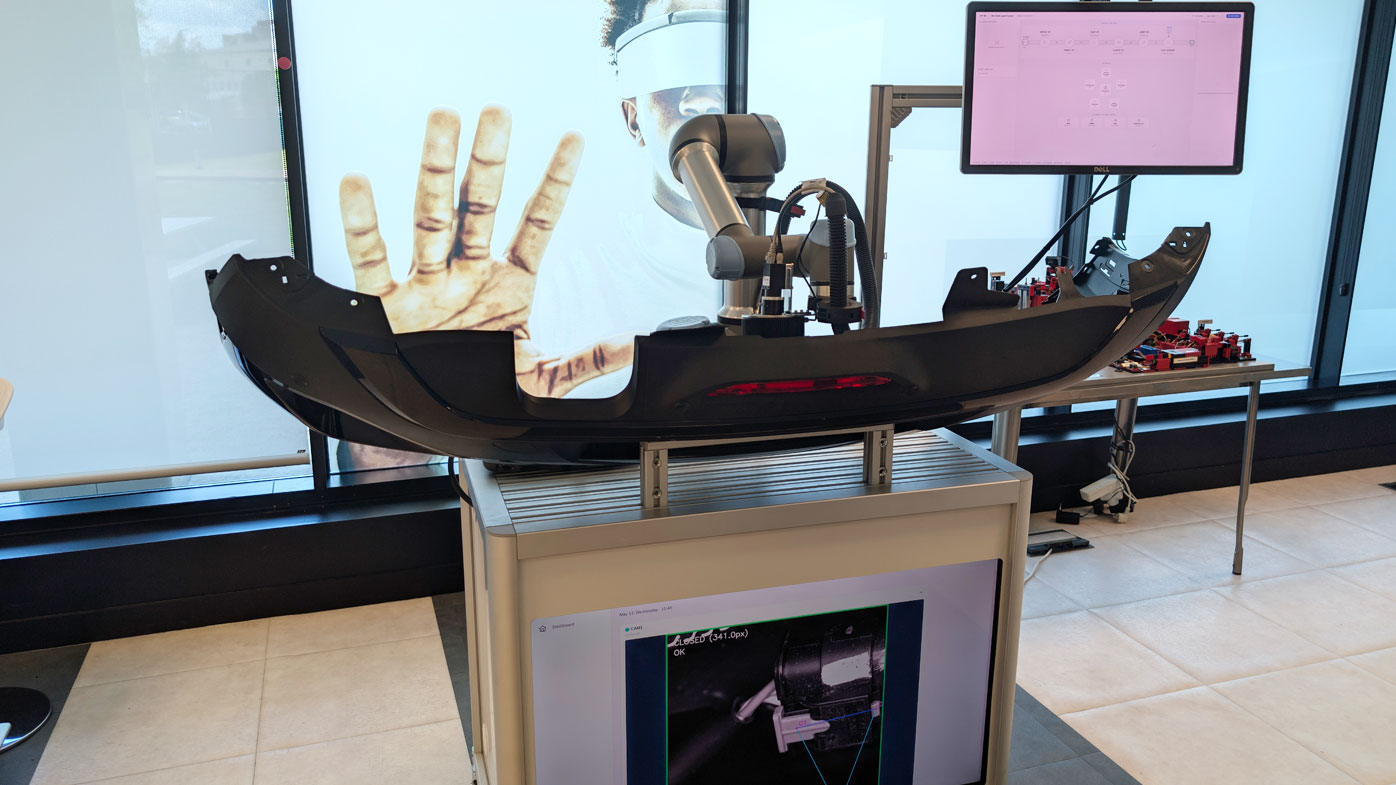
In late April 2026, AI-centric global digital transformation company GFT Technologies released its AI-powered robotic arms that it said are designed for automotive manufacturing.
The three-robot lineup harnesses the power of AI, cloud, edge, vision and robot arms to inspect, identify and remove defective components on the automotive assembly line.
Robots have worked on automotive lines for decades. Assembly, welding, finishing and inspection tasks are common robotic applications in 2026. But what GFT said makes it stand out with its new assembly robot line is the ability to detect and remove defective components without human intervention.
The idea was there. Technology needed to catch up.
“I think what’s really accelerated the adoption to make this more economically feasible for manufacturers is the advancements in AI models,” said Brandon Speweik, head of manufacturing at GFT. “We’re moving from traditional, rule-based decision models to generalized models. Instead of ‘X=Y’ or ‘X=Z’ types of decision-based logic, we can now feed these models examples, and they're able to identify the patterns. This has dramatically improved the accuracy and the ability for us to train these things a lot quicker.”
As AI models improved to enable this training to understand and act on the fly, edge technology followed suit to make these decisions happen in real-time, where the processes are taking place on the assembly line.
“We’ve seen the growth in modern cloud and edge software architectures too,” Speweik said. “You can train the models with limited or different data sets, and then deploy those trained models at the edge so they can run on inference without connectivity or lag issues.”
All the AI advancements that Speweik mentioned are only as good as the data they’re fed. GFT works with its customers to generate or optimize data for the system.
“It’s not a static process, it’s not like you train the model once and it’s done,” Speweik said. “It's a continuous learning system. Our pre-work uses sample data sets to train the system up to a point where it meets a minimum threshold. Then, once it's deployed in production, it continues to learn and get better. The length and the effort that it takes to get the model to a point where it meets those initial thresholds, so you can deploy it, really depends on the complexity of what we're trying to analyze.”
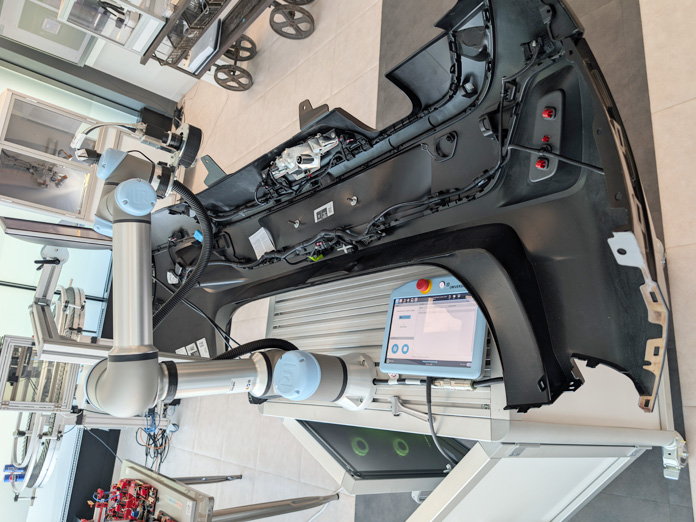
If organizations don’t have that historical data, GFT can develop data collection models to ensure that it trains the models to meet the deployment’s needs.
“Typically, defect detection has involved working with humans,” he said. “It's working with the people who are on the lines, who have those trained eyes that can recognize those defects, issues and patterns. If the data isn’t readily available, we can just take that historical reference data set and use it. We'll work with the customer to capture that new data, and that's what will create the timeline for the model training. If the data already exists, and it's labeled, the deployment can be very fast, almost instantaneous.”
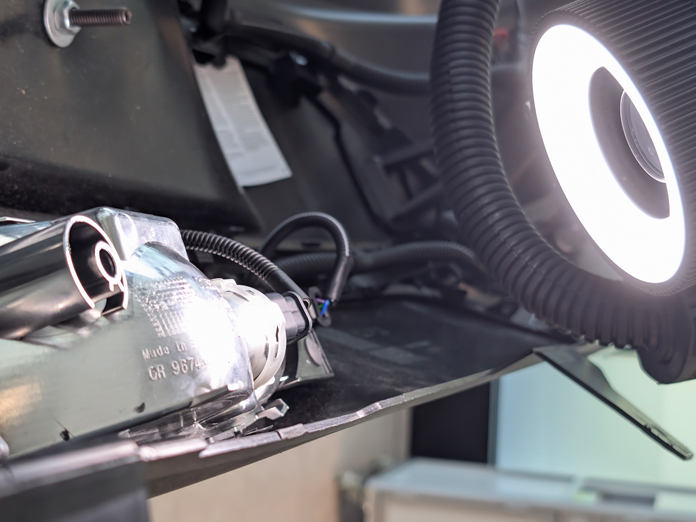
Advancements in cameras and vision systems, as Speweik said, helped make GFT’s AI-powered assembly line robots possible.
One longstanding challenge with robotics and vision systems that GFT said it is tackling is lighting variability.
“That's still very much an element we have to address for every customer, because even when we're running the same vision or AI system for a customer across not just factories, but even assembly lines or different parts of the same facility, we have to take lighting into consideration,” Speweik said. “There are a few ways that we approach that. We can introduce lighting elements or physical setups, like lighting in a controlled box environment, so we can get more of a standardized environment for when the analysis takes place.”
He said that GFT focuses on specific edge cases for defect detection and removal to ensure that the system is ready to see whatever comes down the line, regardless of the lighting conditions.
“We still really go after those edge cases where there are shadows at different times of the day,” Speweik added. “The robustness of the models nowadays, they are very good at identifying patterns. We feed it those different lighting variabilities that will occur throughout the time of day, and it'll be trained on those variable data sets. If there's a scenario where the lighting changes, it's already kind of pre-prepared to identify and recognize that.”
When GFT announced its new robot lineup, the company did so with it already in use at customer sites.
“We already have this running right now for our customers, working in real-time on the production line,” Speweik said. “We have live data coming through. We thought it was time to not just showcase it at an industry event because it was no longer theory. We're actually running this in production now. We have full confidence that we can do this for other customers and scale it so that when the hard question comes, ‘Has this been deployed before?’ We can now answer that with confidence.”
GFT said that this launch builds on the company’s 35+ years of experience helping auto manufacturers - including Ford - modernize their legacy systems and unlock the value of their operational data.
“It's generally available, and the deployment timeline is entirely dependent on the availability of that labeled data from the customer,” he said. “If that data is available, the software development and the AI model training can happen very quickly. Then it's a matter of integrating that into their production line by developing a proper technical hardware configuration and any workflow software at their end. One thing that's a little bit unique about GFT is that we're not just software developers. We're also advisors on the actual hardware implementation as well.”

Tim is the Editorial Director of Robotics247.com. His mission is to provide valuable information and insights to robotics professionals and decision-makers, and to help them solve business challenges. He is a creative, deadline-driven, and detail-oriented storyteller. In addition, he is a sports broadcaster and public address announcer.
GENISOM AI makes ICRA debut at conference in Vienna
World's first omni-modal evaluation including tactile sensing for…
Ultrasonic sensing enhances robotics perception
North America’s largest automation and robotics event takes place June 22-25