By
Tim Culverhouse
December 10, 2025
Adiona Tech
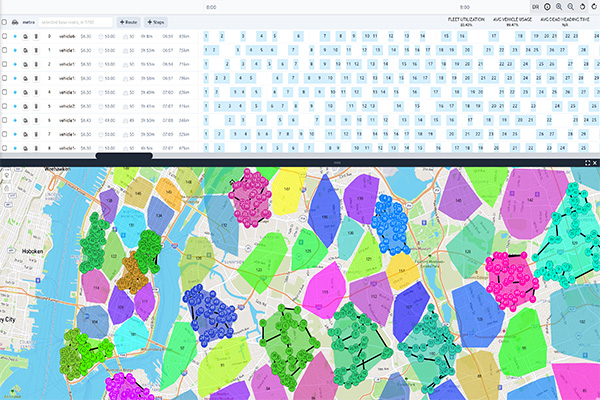
Adiona Tech's FlexOps platform optimizes fulfillment and delivery processes.
Get news, papers, media and research delivered. Sign up for our free newsletters.
Stay up-to-date with news and resources you need to do your job. Research industry trends, compare companies and get weekly market intelligence with Robotics 24/7.

Adiona Tech
Adiona Tech's FlexOps platform optimizes fulfillment and delivery processes.
Founded in 2018 as Staybil, Adiona Tech began when company founder and CEO Richard Savoie overheard a conversation about long-distance travel for part-time work.
Now the Australia-based company, renamed after Adiona, the Roman goddess of safe returns, operates across a variety of industries, including e-commerce, 3PL, logistics, delivery and more.
Adiona Tech’s software portfolio consists of three platforms. Fleet Simulator is a simulation engine. EmissionSense tackles emissions reporting. And FlexOps serves as the command center for delivery operations.
FlexOps, according to the company, helps organizations optimize routes, depot shifts and customer service levels.

Savoie said that as the company developed the technology, there was a lot of algorithmic overlap between commute time (as in the example conversation above that led to Adiona’s founding) and vehicle movement.
“Our earliest deployments were in high-density courier and parcel networks in Australia and New Zealand, where the pain of inefficiency is very visible,” Savoie said. “That grew into broader postal, retail, grocery and field service use cases.”
Regardless of the goods and fleet that Adiona Tech manages with its platform, FlexOps looks for three main categories of data from customers to begin understanding and optimizing delivery routes:
Related to a parcel and postal case study, Savoie said that the company worked with a full year’s worth of data, covering millions of deliveries. This volume of data helps calibrate different types of models to optimize these processes.

And because this data comes from a national postal organization, Savoie explained how FlexOps manages governance and security concerns.
“We provide enterprise deployment options that allow all computation and data handling to occur inside the customer’s controlled cloud environment,” he said. “FlexOps is ISO 27001 compliant, enforces role-based access controls, encrypts data in transit and at rest and logs all API interactions. We also use a proprietary segmentation method that separates personal or identifying information (PII) from the optimisation dataset, so sensitive details never reach the solver. This was important for this customer and formed part of their internal security review, along with most of our enterprise clients.”
Machine learning represents a major component of how FlexOps ingests, analyzes and predicts the best routes and processes for organizations.
The platform’s predictive volume modeling utilizes machine learning models to analyze seasonal patterns, day of week effects, promotional events, regional behavior and historical parcel flows to generate demand forecasts.
More data, such as time and distance prediction models, factors in elements like traffic patterns, building types and others to generate accurate predictions for drivers.
“We developed a USPTO patent-pending set of meta parameters and heuristics that allow the solver to learn from previous scenarios and adjust to conditions in the network,” Savoie said. “This covers parking, walking paths, stop density, terrain and other constraints that affect real-world delivery.”
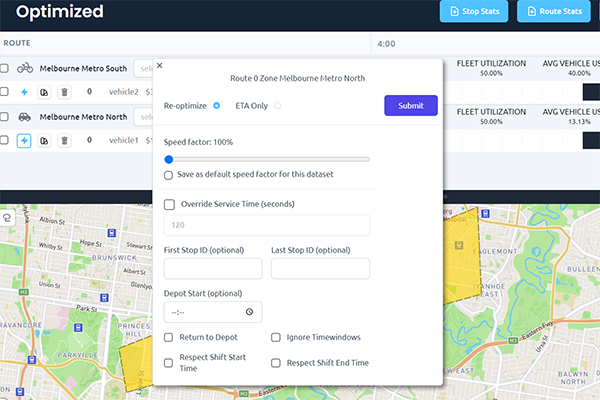
FlexOps also utilizes a diagnostics tool to present more data and benchmarking targets.
“Our Diagnostics Engine produces automated insights that help planners understand where volume surges will create operational strain, and what adjustments will have the largest positive impact,” Savoie said.
Savoie said the FlexOps platform usually sits in one of two places.
In systems that generate orders, allocate work and initiate route planning, Savoie said FlexOps usually sits upstream, including WMS, OMS, ERP platforms and parcel induction systems.
For delivery applications, mobile driver apps, telematics and customer tracking systems, FlexOps sits downstream. This location allows these platforms to consume routes, ETAs and diagnostic information generated by FlexOps.
“It is intentionally system agnostic,” Savoie said. “We do not replace a WMS or TMS. Instead, FlexOps provides the intelligence layer that those systems call when they need accurate routing, fleet allocation and predictive diagnostics.”
Peak season is demanding for everyone in the e-commerce segment. Adiona Tech and FlexOps are no different.
When organizations have more orders to process and more parcels to deliver, it’s critical that all hardware and software platforms can handle the holiday rush.
“Peak season is one of the main problems FlexOps was built to solve,” Savoie said. “Postal and parcel volumes can nearly double for some operators in November and December, and static routing tools tend to fail under those conditions. FlexOps automatically scales horizontally as volume increases.”
The Diagnostics Engine allows operators to simulate peak demands before they occur. Savoie said users can run thousands of scenarios to stress test their network, and potentially identify and eliminate bottlenecks before they ever occur.
“During peak, our customers rely on FlexOps to maintain service levels, protect on-time performance and reduce the cost of temporary labor and vehicle rentals,” he said.

Tim is the Editorial Director of Robotics247.com. His mission is to provide valuable information and insights to robotics professionals and decision-makers, and to help them solve business challenges. He is a creative, deadline-driven, and detail-oriented storyteller. In addition, he is a sports broadcaster and public address announcer.
GENISOM AI makes ICRA debut at conference in Vienna

World's first omni-modal evaluation including tactile sensing for…

Ultrasonic sensing enhances robotics perception

Cybernetix Ventures’ event kicks off Robotics Tech Week 2026 slate of events